
Tag: cloning
-
A few tips on working with digested fragments in the Cloning Clipboard
The Cloning Clipboard is an easy, and flexible, way to design and document your cloning strategies. Here’s two tips on manipulating a single fragment.
-
Designing and documenting cloning strategies
Designing cloning strategies is easy with the Cloning Clipboard. You can perform quite complex ligations by simply dragging compatible ends together. However, when you open this construct a year later, you don’t want to have to look back in your lab book to know how you generated it. Neither do you need to! MacVector fully…
-
Create constructs using the Cloning Clipboard
You can create new constructs in MacVector by selecting two restriction enzyme sites, choosing Edit -> Copy, selecting a target restriction site in a different molecule and then choosing Edit -> Paste. It works great and fully understands compatible overhanging sticky ends preventing you from accidentally creating biologically impossible molecules. However, a far more flexible…
-
Removing a restriction site from a plasmid with the Cloning Clipboard
Being able to remove a restriction site by digesting with an enzyme that cuts at one site to linearize a plasmid, Klenow treating the linear fragment, then religating the fragment, is a useful trick in the lab. It can help you produce a suitable, and simple, cloning site when none previously existed in your vector.…
-
How to select all identical restriction enzyme sites
The Automatic Restriction Enzyme Analysis tool that is displayed on the sequence in the Map tab is very powerful. It automatically displays a custom set of restriction enzyme recognition sites on every sequence that you open. Unique recognition sites are displayed in red and sites with two or more cut locations are displayed in blue.…
-
Restriction enzyme sites in cloning vectors show compatible ends with fragments in the Cloning Clipboard
If you are looking for compatible cloning sites for a fragment, MacVector has a simple color-coded function to identify potential target sites in a vector. First select the fragment you wish to clone by clicking on two enzymes in the Map view of a single sequence document or from a restriction enzyme search result. Then…
-
Restriction enzyme sites and tooltips
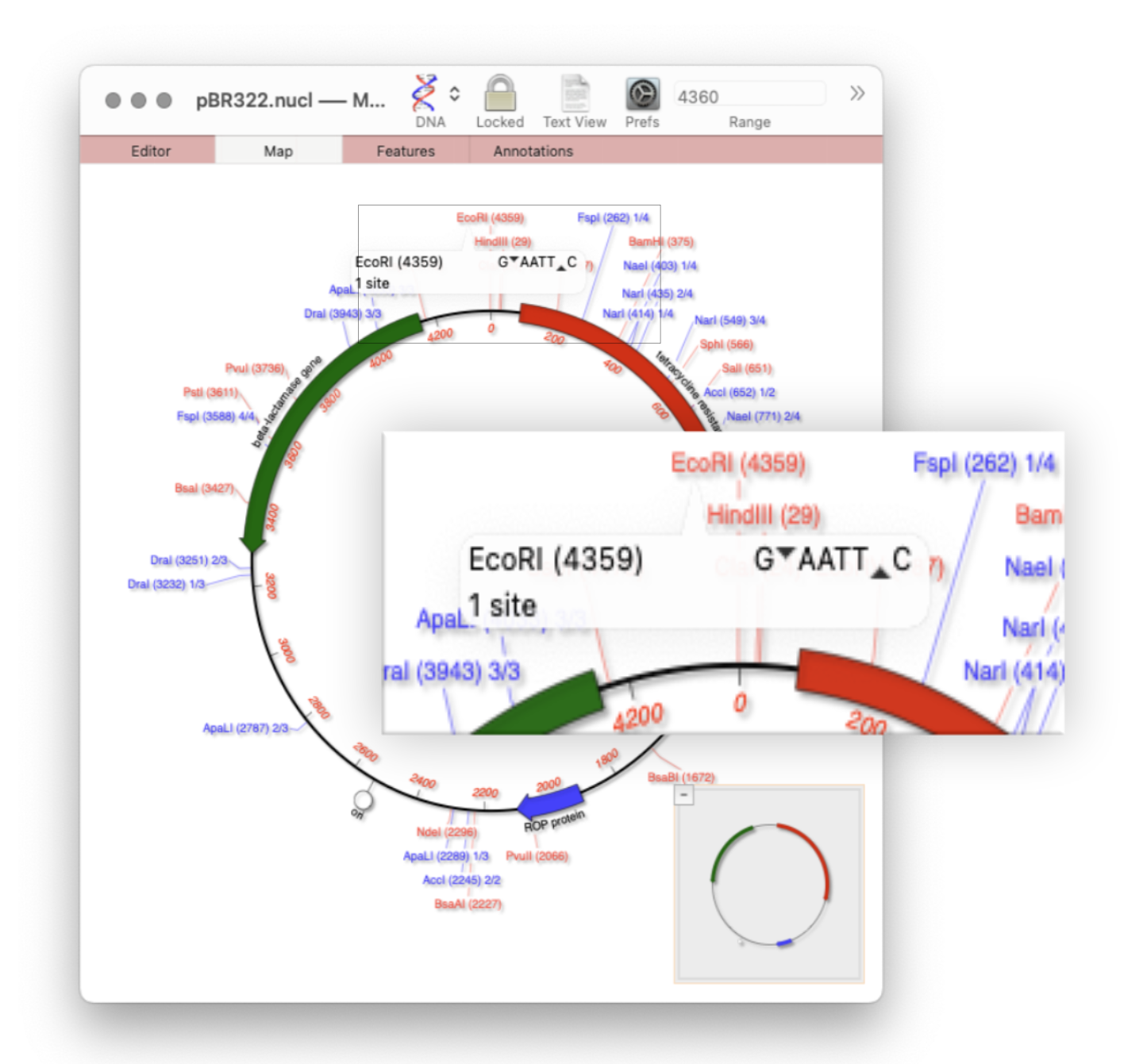
Quickly viewing the recognition sequence and cut site of a restriction site is very easy in the Map tab. If you hover your mouse over a restriction site in the Map tab, a tooltip will show you the restriction enzyme recognition site, the location of the cut site, and number of times that enzyme cuts…
-
MacVector for Windows: update.
It’s quite a few months since the last update on the development of MacVector for Windows. Work is progressing very well and a lot of the underlying functionality is now finished. The Cloning Clipboard, Restriction Enzyme analysis and QuickTest Primer tools are all done. The release is still some time away, but if you are…
-
Use the [option] key to paste, or ligate, in the opposite orientation
The most simple way of generating new constructs in MacVector using restriction enzyme sites is to: MacVector is intelligent enough to understand compatible sticky ends during this procedure and will prompt if they do not match. For a simple cloning (e.g. inserting a copied EcoRI fragment into the EcoRI site of a vector), by default,…
-
Creating cloning construction flowcharts in third party applications
We’ve previously discussed how every ligation is documented. You get a “Frag” annotation that contains the date, source sequence, enzymes used and any end modification that was done to that fragment during the ligation. However, we had regular requests to make it easier for user to document their constructs in other ways. For example being…