
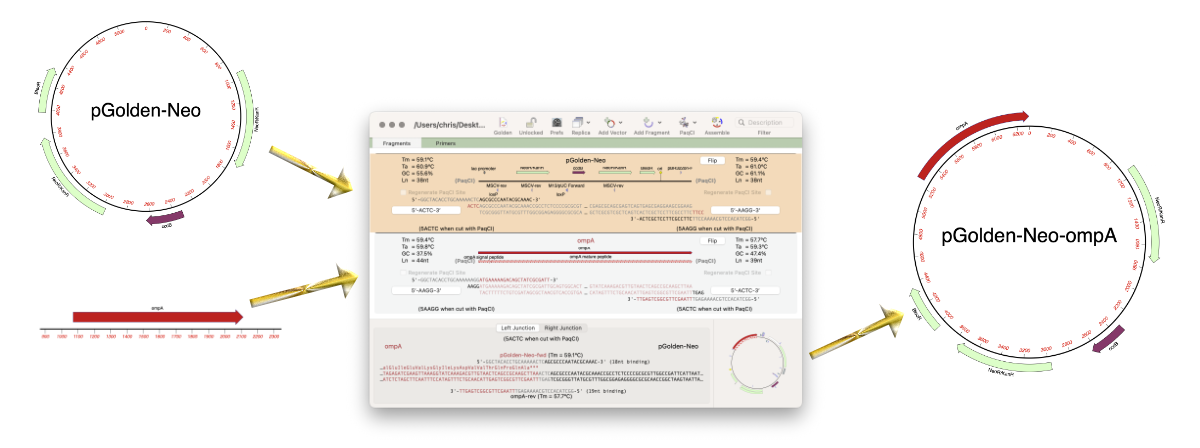
MacVector 26 was released last week (13 July 2026) and it’s a significant release. MacVector 26 has new features for designing and documenting cloning workflows and for managing your sequences. The new Cloning Project Manager allows you to design Golden Gate Cloning workflows. So along with Ligase Independent Cloning, Gibson Assembly and traditional restriction enzyme based cloning projects you have a single place to manage cloning projects. Together with the Cloning Clipboard this makes MacVector the premier tool to help molecular biologists design and document cloning workflows, whatever the cloning method used, with ease.
As well as the Cloning Project Manager, the Assembly Project Manager has been renamed to the Sequence Project Manager because now there’s a lot more functionality than just sequence assembly. These two new tools will make organising your sequence analysis workflows easier than ever!
As well as these new tools there’s many smaller changes and bug fixes. Plus some “under the hood” changes to make MacVector more secure and more optimized. For example following Apple’s guidelines MacVector is now a Sandboxed application.
Read What’s New in MacVector 26 for a full list.
MacVector 26 is a Universal Binary supported on any Intel or Apple Silicon Macintosh running macOS 11.5 (Big Sur) to macOS Tahoe (26).
Why the version jump?
Over the last 12 months, Apple have committed to numbering their operating system release by year, so macOS Tahoe is macOS 26. That makes it easy to remember the release year. Accordingly, we have decided to match that, so, going forwards, all major MacVector releases will be numbered based on the year of release. We will still release complimentary bug fixes as e.g. “26.0.1” etc, so there may be complimentary maintenance releases in 2027 that still have “26” as the initial version number.
Golden Gate Cloning
One of the major new functions is support for Golden Gate Cloning. The basic idea behind this is that you can design primers to create PCR products where you can cut with Type IIS enzymes that asymmetrically cleave to one side leaving 4 nt overhangs and design multiple inserts, each with a different but complementary 4 nt overhang such that you can (potentially) assemble 20 or more fragments to a viable clone in a one-pot reaction. MacVector’s Cloning Project Manager goes way beyond simple Golden Gate Cloning interfaces such as the popular NCBI tool.
With MacVector’s Cloning Project Manager designing and documenting Golden Gate Cloning workflows is easy. A typical workflow would be:
- Select a vector.
- Drag and drop one or more features (e.g. a gene, an expression tag etc.) to your cloning project.
- Choose a suitable Type II enzyme.
That’s it! In all cases MacVector will sort fragments and also automatically generate primers if needed to make them assemble.
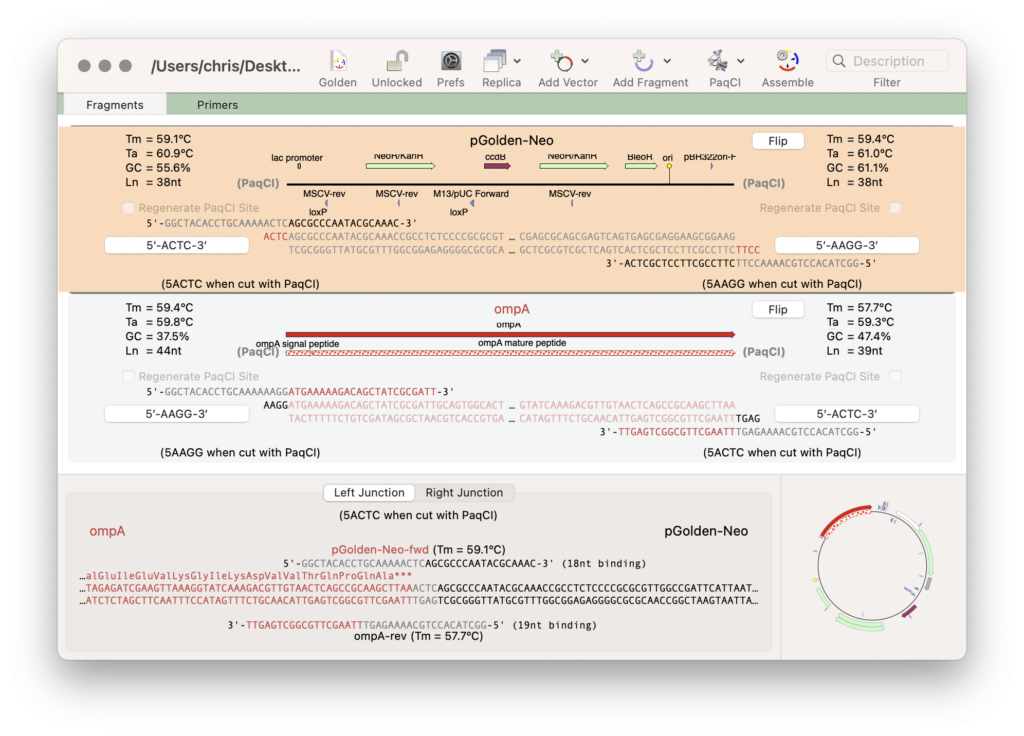
The Cloning Project Manager has many useful features to design and document from simple to very complex Golden Gate Cloning workflows.
- Fragments to clone can be blunt ended or digested.
- You can edit any primer to modify open reading frames.
- View the junctions between fragments to confirm the fusion protein is correct.
- Export the predicted result of the assembly as a new sequence.
- Export a list of all the required primers
- …and (perhaps most impressive of all!), if you drag and drop a bunch of existing constructs to the Cloning Project Manager then MacVector will automatically work out if a new construct can be created by combining those vectors, the selected enzyme and T4 DNA ligase into the same one-pot tube. Fans of the MoClo system (and many similar) should love this.
Cloning Project Manager
To support Golden Gate Cloning there’s a new Cloning Project Manager. This allows you to design and document cloning workflows using an intuitive drag and drop of vector, inserts and more.
- Golden Gate Cloning
- Gibson Assembly
- Ligase Independent Cloning
- Restriction enzyme based cloning
Batch BLAST of Protein Sequences
You can now batch BLAST protein sequences. Just add one or more protein sequences to the Sequence Project Manager and select Database | Online Search for Similar Sequences (BLAST)… and this will run BLAST on the selected sequences. The results contain a summary window that lists the best hits for each protein sequence
Sequence Project Manager
Because of the increasing functionality that has been added we have renamed the Assembly Project manager to Sequence Project Manager. It’s not just that you can now batch BLAST protein sequences as you can also batch translate CDS features across multiple sequences, batch Auto Annotate sequences and more. Future releases of MacVector will take advantage of this to use the Sequence Project Manager as a general organizational project for sequences where many different analysis functions will be able to directly operate on items in the projects.